Blog / 2026 Chevrolet Blazer EV

Law Enforcement Electric Vehicles NY: 2026 Chevrolet Blazer EV: The Future of Policing: Electric Vehicles in New York

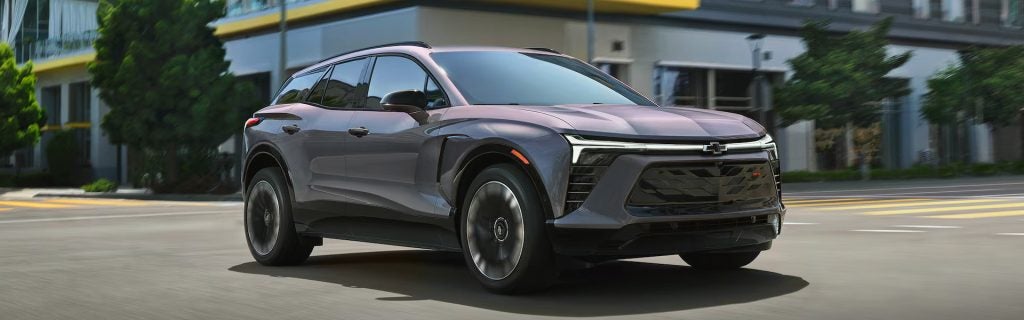
White Chevrolet Blazer EV driving on urban street.

As the automotive industry shifts toward sustainability, law enforcement agencies in New York are exploring innovative solutions to reduce emissions and operating costs. The 2026 Chevrolet Blazer EV, equipped with a specialized Police Package, is emerging as a game-changer for law enforcement electric vehicles in NY. With its impressive range, advanced technology, and robust performance, this electric SUV is tailored to meet the demanding needs of modern policing. 

Why the Chevrolet Blazer EV Stands Out for Law Enforcement 

Performance and Range for All-Day Patrols 

The 2026 Chevrolet Blazer EV offers up to286 miles of EPA-estimated range with dual-motor AWD on a full charge, making it ideal for the rigorous demands of law enforcement in Long Island City, NY. The Blazer EV is the only pursuit-rated, purpose-built police package EV, and it can reach a top speed of 130 MPH with 498 hp and 531 lb-ft of torque The available all-wheel-drive (AWD) system ensures optimal traction and control, even in challenging weather conditions.  

Advanced Technology for Modern Policing 

Equipped with a 17.7-inch touchscreen and an 11-inch driver information display with Google built-in capability, the Blazer EV keeps officers connected and informed. The Chevrolet Blazer EV Police Package includes advanced safety systems such as Forward Collision Alert and Automatic Emergency Braking.  

The Blazer EV Police Package also has a trailering capacity of 1,000 lbs, a dedicated 400-volt to 12-volt Power Module Reducer to support emergency equipment, Heavy-duty police-rated suspension, and steel underbody skid plates. 

Cost Efficiency and Sustainability 

Switching to electric vehicles like the Blazer EV can significantly lower fuel and maintenance costs for law enforcement agencies. The Blazer EV PPV supports multiple charging levels, including 19.2 kW Level 2 station and 190 kW DC Fast Public Charging adding up to 71 miles of range in 10 minutes to help minimize downtime and keep officers on the road. 

Benefits of the Blazer EV AWD for Police Use 

The AWD capability of the Chevrolet Blazer EV Police Package is particularly advantageous for law enforcement in New York. Whether navigating icy streets in winter or pursuing suspects off-road, the AWD system provides reliability and stability. Additionally, the spacious interior offers up to 25.5 cu ft of cargo space behind the second row, accommodating essential equipment. 

Major World Chevrolet Can Help Get Your Department on the Road to an EV Fleet 

Ready to explore how the 2026 Chevrolet Blazer EV can elevate your department's fleet? Visit Major World Chevrolet in Long Island City, NY to learn more about the Chevrolet Blazer EV Police Package and its potential to transform law enforcement electric vehicles in NY. 

Posted in:

Related Posts

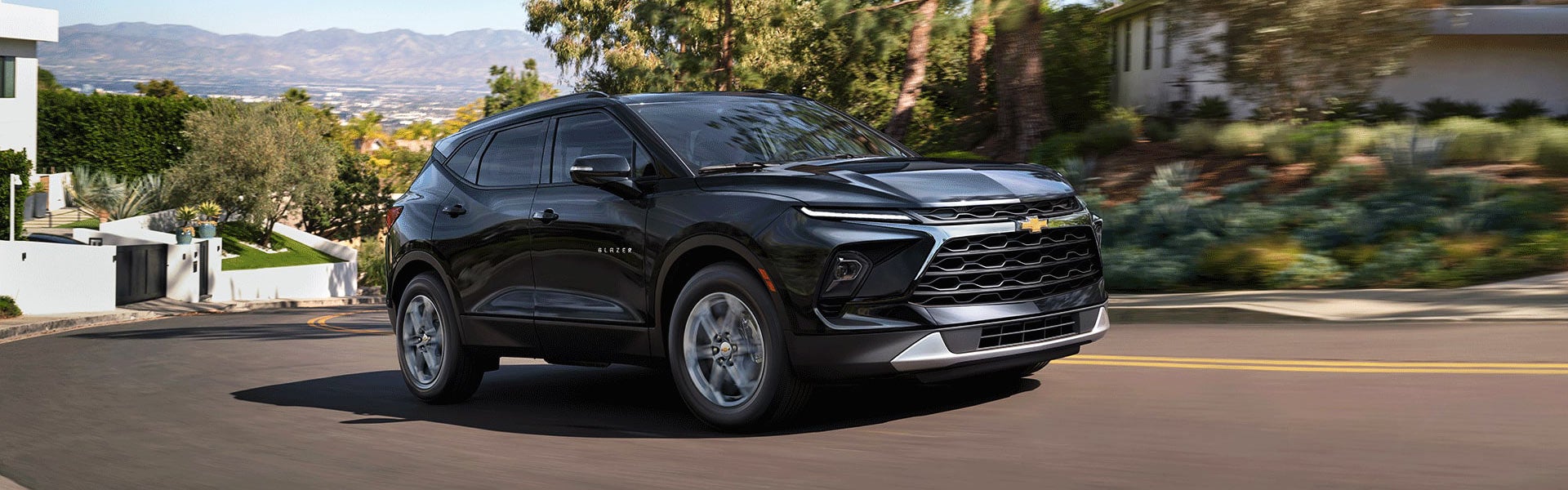
Black Chevrolet Blazer SUV driving on a road.

Chevy Trailblazer vs. Blazer vs. Equinox: Which SUV Is Right for You?

If you're shopping for a new Chevrolet SUV and feeling a little overwhelmed by the options, we’re here to help. The Trailblazer vs. Blazer vs. Equinox comparison is one of the most common ones that Chevy SUV buyers consider, and for good reason - each model serves a distinct type of driver. If you're a first-time buyer in Long Island City, NY or simply ready to upgrade, here's a breakdown to help you decide. The 2026 Chevy Trailblazer: Compact and Budget-Friendly The Trailblazer is Chevrolet's most affordable SUV in this group, making it a smart choice if you want to keep costs manageable without giving up style or technology. It's a compact crossover that handles city streets and light highway driving with ease. It has a towing capacity of 1,000 lbs when properly equipped and it gets an EPA-estimated 31 MPG combined with the available 1.3L turbo engine and FWD. All-wheel drive is also available. And while it is a smaller SUV, it does have room for cargo, with the passenger front seat folded flat, the Trailblazer can accommodate a max cargo length of 8.5-ft. When comparing the Trailblazer vs. Blazer vs. Equinox, the Trailblazer stands out for buyers who prioritize value and a smaller footprint. It's easy to park, fuel-efficient, and comes packed with features that feel well above its entry price point. The 2027 Chevy Equinox: The Well-Rounded Middle Ground The Equinox is in the middle of the Chevy SUV lineup. It offers more interior space than the Trailblazer and a more stylish feel overall, making it ideal for small families, commuters, and weekend travelers alike. It’s powered by a 1.5L turbo engine that puts out 175 hp and 203 lb-ft of torque and a max towing capacity of 1,500 lbs. Front-wheel drive comes standard, and all-wheel drive is available. In the Chevy Trailblazer vs Blazer vs Equinox conversation, the Equinox is often the one that appeals to the widest range of buyers. It balances cabin comfort, cargo space, and connected technology in a package that doesn't ask you to compromise on much. It's also available in an all-electric Equinox EV variant for drivers who want to go emissions-free. The 2026 Chevy Blazer: Space, Style, and Performance The Blazer is the most high-end of the three SUVs in this comparison. It features a sportier exterior design and a more upscale interior, making it the right pick for drivers who want their vehicle to make a statement. The Blazer has a max cargo volume of 64.2 cu ft, giving you plenty of room for whatever you need to bring with you. It gets an estimated 19 MPG city and 29 MPG highway. The Blazer comes with a choice of two powertrains. The standard 2.0L 4-cylinder turbo puts out 228 hp and 258 lb-ft of torque. There is also an available 3.6L V6 with 308 hp and 270 lb-ft of torque. It can tow up to 4,500 lbs with the 3.6L V6 engine and the available trailering package. When you line up the Trailblazer vs. Blazer vs. Equinox, the Blazer leans into bold styling and a more commanding presence on the road. It also offers a larger cabin and additional available features, which makes it a natural fit for those who want something closer to a luxury SUV experience without fully crossing into that territory. Like the Equinox, the Blazer is also available in an all-electric version. Which One Should You Choose? Here's the simplest way to think about it. If you want an affordable, compact SUV that's easy to maneuver and great on a budget, the Trailblazer makes a lot of sense. If you need a well-balanced, family-friendly crossover with strong everyday utility, the Equinox is a great fit. And if you want something that looks sharp and feels stylish, the Blazer is a good choice. Visit Major World Chevrolet to Find Your Fit No amount of reading replaces sitting in the driver's seat. The team at Major World Chevrolet is ready to help you explore the Trailblazer vs. Blazer vs. Equinox in person and find the model that truly fits your needs. Browse current inventory and available offers online, or stop by to take one - or all three - for a test drive today.

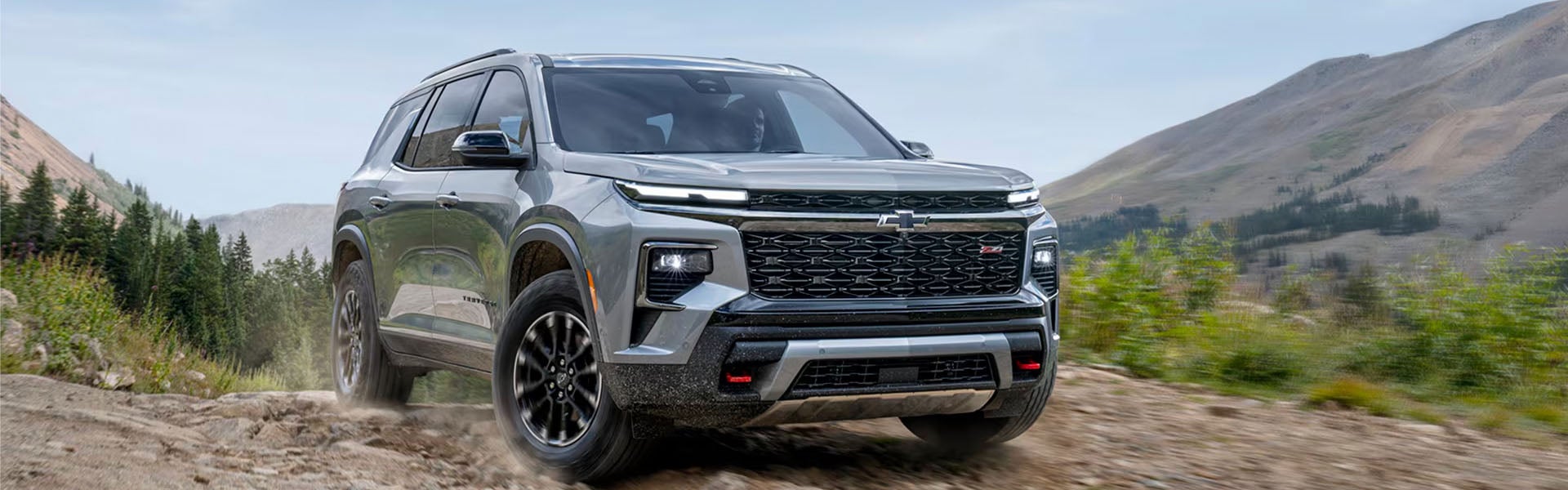
Silver Chevrolet SUV driving on an off-road trail.

Chevy Traverse Towing Capacity: How Much Can the Traverse Tow?

Are you in the market for a three-row SUV that also has serious towing capacity? Then the Chevy Traverse is the vehicle you’re seeking. No matter if you're hauling a small camper, a boat, or a utility trailer in Long Island City, NY, knowing what your vehicle can handle matters before you commit. The Traverse is one of Chevrolet's most popular full-size SUVs, offering a comfortable ride, generous passenger space, and utility. But how much can a Chevy Traverse tow? Here's what you need to know. Chevy Traverse Towing Capacity Overview The 2026 Chevrolet Traverse can tow up to 5,000 lbs when properly equipped, giving New York City-area families flexibility for trips beyond the five boroughs. That capacity can be useful for pulling a compact camper for weekends in the Catskills, a small boat or personal watercraft for trips to the Jersey Shore or Long Island, or a utility trailer for moving larger items and tackling home projects. To reach that maximum towing capacity, the vehicle needs to be configured with the available towing package. Without that package, towing capacity is lower, so it's worth confirming the specific trim and equipment on any vehicle you're considering. What Can You Actually Tow? To understand how much can a Chevy Traverse tow in real-world terms, it helps to put that 5,000-lbs rating in context. A typical pop-up camper weighs around 2,000 to 3,000 lbs. A smaller powerboat with its trailer might come in around 3,500 lbs. A pair of personal watercraft on a tandem trailer can easily fall within that 5,000-lb limit. For everyday tasks like hauling a small trailer, moving equipment, or bringing a side-by-side to the trails, the Traverse can handle it. It's not a heavy-duty work truck, but it covers a wide range of recreational and practical towing needs. Towing Features Worth Knowing The Traverse is built with features that make towing more manageable. Available equipment includes trailer sway control, which works with the vehicle's stability systems to help maintain control when a trailer shifts unexpectedly. The available integrated trailer brake controller is another useful addition, especially if you're towing heavier loads that require supplemental braking. Combined with the Traverse's EcoTec3 engine options, you get a powertrain that can pull with confidence without constantly feeling strained. Is the Traverse the Right Vehicle for You? If towing is your main need, the Chevrolet Traverse can be a strong fit for Long Island City families who want SUV comfort and passenger space without giving up the flexibility to tow for weekend trips. Before deciding, compare your fully loaded trailer weight, passengers, cargo, and required equipment with the Traverse’s available 5,000-lb maximum towing rating when properly equipped. If your towing needs regularly exceed 5,000 lbs, stepping up to the Silverado or Tahoe might make more sense. But for most recreational hauling, the Traverse gets the job done without sacrificing the comfort and practicality that make it such a strong family vehicle. Visit Major World Chevrolet Understanding the Chevy Traverse’s towing capacity is just the starting point. The right configuration, trim level, and options all play a role in what you can actually haul. The team at Major World Chevrolet can help you explore available Traverse inventory and find the model that fits your lifestyle. Stop by or visit us online to browse current inventory and connect with a product specialist who knows the Traverse inside and out.

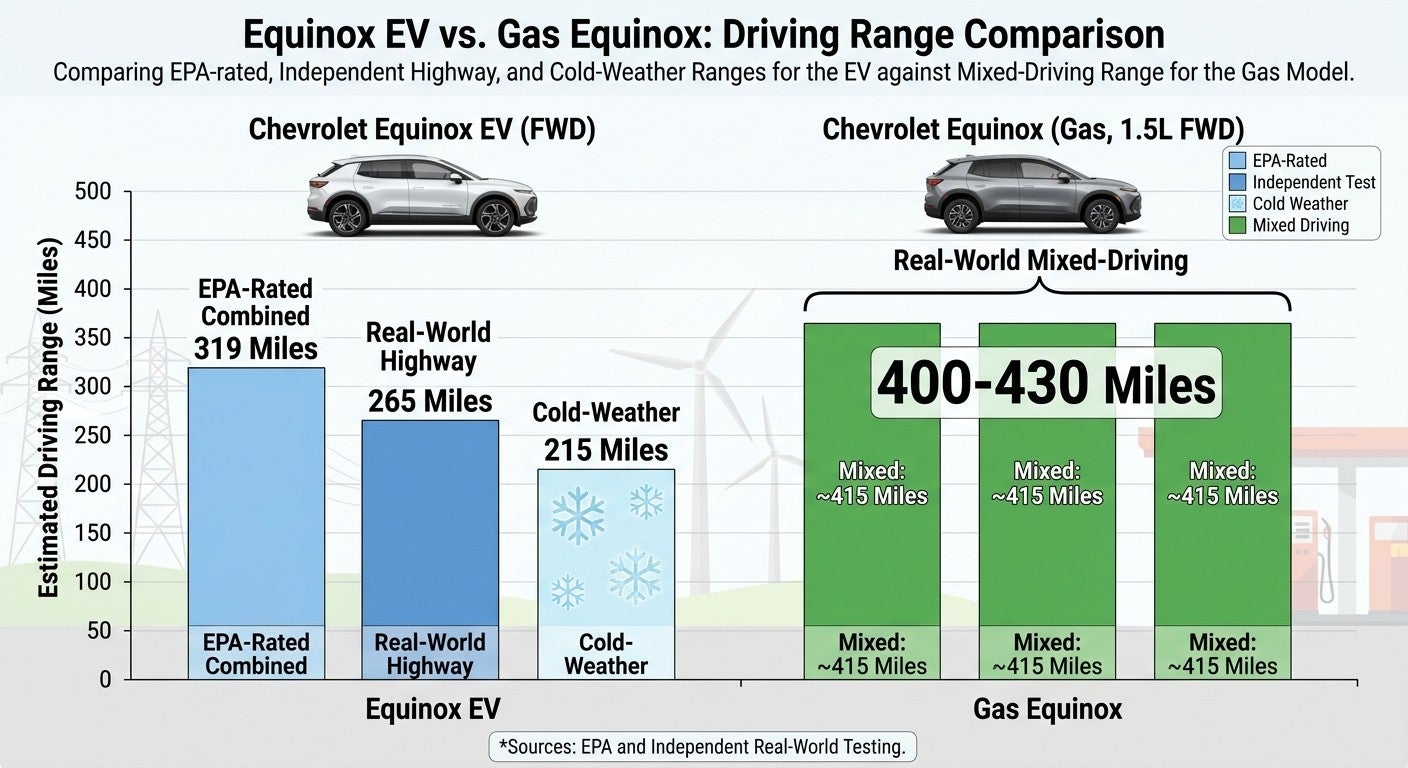
Bar chart comparing Equinox EV and gas Equinox range across EPA rating, real-world highway driving, and cold weather

Equinox EV vs. Gas: Range, Tax Credit & Charging

Equinox EV vs. Gas Equinox: Range, Tax Credit, and Charging Explained Going electric with a Chevy means giving something up and getting something else in return, and the trade is bigger than most shoppers expect walking in. Here's the real range gap between the Equinox EV and the gas Equinox, where the federal tax credit actually stands, what a home charger setup costs before delivery day, and how the Equinox EV and Blazer EV actually compare at a fast charger. How does the Equinox EV's real-world range compare to the gas Equinox? Roughly 230 to 260 miles for the Equinox EV against 400 to 430 miles for the gas Equinox in mixed driving, so figure the gas model goes about 60 to 70% farther between fill-ups than the EV goes between charges. The EPA numbers look closer than that, 319 miles for front-wheel-drive Equinox EV, 307 for all-wheel-drive, but independent highway testing at 75 mph lands both versions closer to 260 miles, and that's before winter takes a bite out of it. Cold weather changes the math further. In 6°F weather during a 60-mile drive, the energy monitor showed 1.6 to 1.7 miles per kWh on the way out, improving to 2.2 miles per kWh on the return trip as the battery warmed up. You can easily see range dropping to 100 miles during a bad winter storm. The gas Equinox doesn't have that problem, cold weather costs it a little efficiency but nothing close to a third of its range. Does the Equinox EV or Blazer EV still qualify for the federal EV tax credit? No. The federal EV tax credit that used to knock a meaningful chunk off the price was eliminated for new-vehicle purchases by recent legislation, and that applies to the Equinox EV and Blazer EV the same as every other EV on the market. The credit that used to make these two Chevy EVs a lot cheaper on paper is simply gone for a normal new purchase. There's one narrow exception worth knowing about: as long as a shopper entered a binding contract to buy a vehicle before the cutoff, the purchase can still qualify for the credit even if the car wasn't delivered until later, provided a real down payment or trade-in changed hands before that date too. Outside of that specific paperwork trail, what's left is smaller and comes with fine print. Finance a U.S.-assembled EV, and both the Equinox EV and Blazer EV qualify since they're built here, and you can deduct a meaningful chunk of your auto loan interest each year under a separate provision, a real benefit, but nowhere near what the old purchase credit was worth. There's also a modest home-charger installation credit, but only if you happen to live in a low-income or non-urban census tract, most suburban buyers won't qualify for that one at all. Do the math yourself before you get excited: none of it comes close to replacing what used to come straight off the purchase price. Tax law shifts more than most car buyers expect. Confirm the actual rule before you build a budget around any of it. What home charging equipment do you need before delivery, and what does it actually cost? A dedicated 240V circuit and a Level 2 charging unit, and the honest range runs from a few hundred dollars for a straightforward install to well into four figures if your electrical panel needs work. That range breaks down roughly like this once you actually itemize a quote: a modest sum for the charger unit itself, a comparable amount for a licensed electrician's labor, and a smaller add-on for permits and inspection, which most jurisdictions require for any 240V work. Nobody quotes it that way up front, dealers and chargers both tend to just hand you a single number, but knowing the pieces helps you tell whether a quote is padded. The real cost driver isn't the charger, it's what's already in your garage. A Level 2 setup needs a dedicated 40 to 60 amp circuit, and if your panel is already near capacity, a panel upgrade or sub-panel adds a genuinely significant amount on top of everything else, often more than the rest of the install combined. This is exactly where quotes tend to balloon when the electrician discovers surprises: a cramped or ancient panel, aluminum branch wiring, a hidden splice. Get an electrician to actually look at your panel before you assume the low end applies to you, and get the quote in writing before delivery day, not after the car is already sitting in your driveway on a Level 1 trickle charge. How long does it take to DC fast charge an Equinox EV vs. a Blazer EV? About the same, unless you pay up for the Blazer EV's bigger battery option. Both the Equinox EV and the base Blazer EV configurations use an 85 kWh battery capped at 150 kW peak DC fast charging, and real-world testing on that setup shows the car rarely holding above 96 to 100 kW even on a faster charger, which puts a realistic 10 to 80% charge at around 40 to 44 minutes rather than the sub-30-minute numbers some EVs advertise. Step up to the Blazer EV's RWD or SS AWD trim with the larger 102 kWh battery and the peak charging rate jumps to 190 kW, GM's own numbers claim up to 80 miles added in about 10 minutes on that configuration versus roughly 68 miles for the standard Blazer EV and 77 miles for the Equinox EV. The Equinox EV doesn't offer that bigger battery at all, so if fast-charging speed specifically is the deciding factor between these two, it comes down to which Blazer EV trim you're looking at, not which nameplate. Bottom line The range gap is real and worse in winter, plan around 230 to 260 miles for the EV against 400-plus for gas, not the EPA sticker numbers. The federal tax credit that used to make new EVs meaningfully cheaper is gone for a normal purchase, so don't build your budget around it unless you locked in a binding contract before the cutoff. Home charging installation typically runs from a few hundred dollars to a couple thousand, but get your panel checked before you trust the low end, panel work is what turns a cheap install into an expensive one. And on fast charging, Equinox EV and base Blazer EV charge at the same modest pace, the only way to actually charge faster is stepping up to the Blazer EV's bigger battery trims.