




Blog / Long Island City Chevrolet Dealer

Chevy Trailblazer vs. Blazer vs. Equinox: Which SUV Is Right for You?

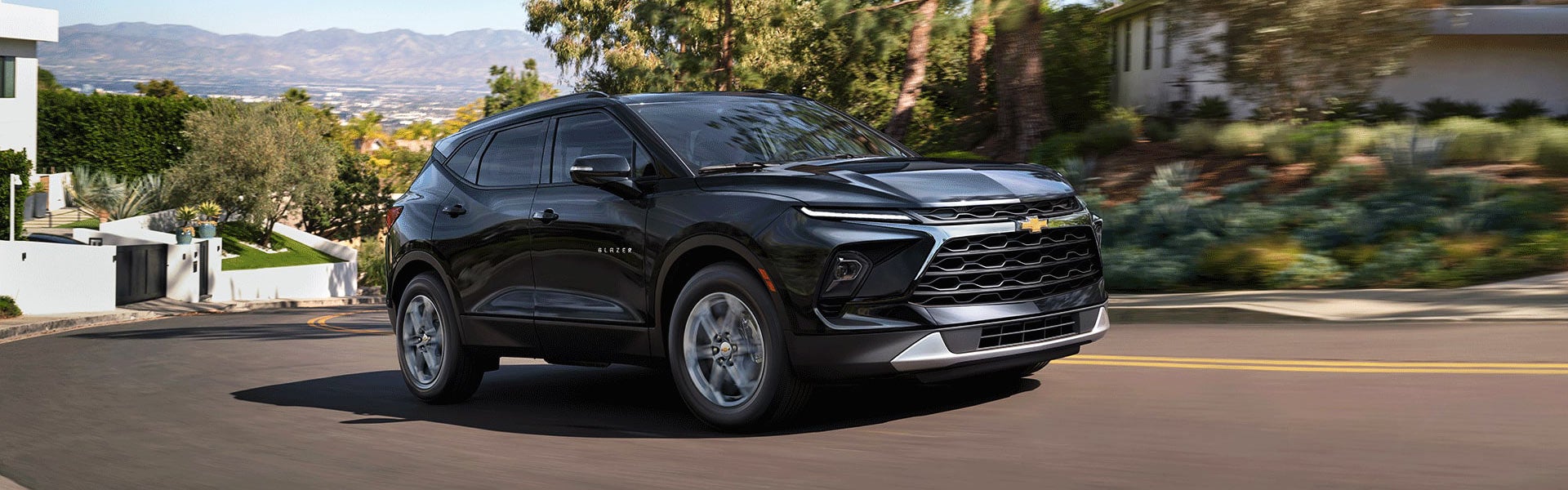
Black Chevrolet Blazer SUV driving on a road.
If you're shopping for a new Chevrolet SUV and feeling a little overwhelmed by the options, we’re here to help. The Trailblazer vs. Blazer vs. Equinox comparison is one of the most common ones that Chevy SUV buyers consider, and for good reason - each model serves a distinct type of driver. If you're a first-time buyer in Long Island City, NY or simply ready to upgrade, here's a breakdown to help you decide.

The 2026 Chevy Trailblazer: Compact and Budget-Friendly


The Trailblazer is Chevrolet's most affordable SUV in this group, making it a smart choice if you want to keep costs manageable without giving up style or technology. It's a compact crossover that handles city streets and light highway driving with ease.

It has a towing capacity of 1,000 lbs when properly equipped and it gets an EPA-estimated 31 MPG combined with the available 1.3L turbo engine and FWD. All-wheel drive is also available. And while it is a smaller SUV, it does have room for cargo, with the passenger front seat folded flat, the Trailblazer can accommodate a max cargo length of 8.5-ft.

When comparing the Trailblazer vs. Blazer vs. Equinox, the Trailblazer stands out for buyers who prioritize value and a smaller footprint. It's easy to park, fuel-efficient, and comes packed with features that feel well above its entry price point.

The 2027 Chevy Equinox: The Well-Rounded Middle Ground


The Equinox is in the middle of the Chevy SUV lineup. It offers more interior space than the Trailblazer and a more stylish feel overall, making it ideal for small families, commuters, and weekend travelers alike.

It’s powered by a 1.5L turbo engine that puts out 175 hp and 203 lb-ft of torque and a max towing capacity of 1,500 lbs. Front-wheel drive comes standard, and all-wheel drive is available.

In the Chevy Trailblazer vs Blazer vs Equinox conversation, the Equinox is often the one that appeals to the widest range of buyers. It balances cabin comfort, cargo space, and connected technology in a package that doesn't ask you to compromise on much. It's also available in an all-electric Equinox EV variant for drivers who want to go emissions-free.

The 2026 Chevy Blazer: Space, Style, and Performance


The Blazer is the most high-end of the three SUVs in this comparison. It features a sportier exterior design and a more upscale interior, making it the right pick for drivers who want their vehicle to make a statement.

The Blazer has a max cargo volume of 64.2 cu ft, giving you plenty of room for whatever you need to bring with you. It gets an estimated 19 MPG city and 29 MPG highway.

The Blazer comes with a choice of two powertrains. The standard 2.0L 4-cylinder turbo puts out 228 hp and 258 lb-ft of torque. There is also an available 3.6L V6 with 308 hp and 270 lb-ft of torque. It can tow up to 4,500 lbs with the 3.6L V6 engine and the available trailering package.

When you line up the Trailblazer vs. Blazer vs. Equinox, the Blazer leans into bold styling and a more commanding presence on the road. It also offers a larger cabin and additional available features, which makes it a natural fit for those who want something closer to a luxury SUV experience without fully crossing into that territory. Like the Equinox, the Blazer is also available in an all-electric version.

Which One Should You Choose?


Here's the simplest way to think about it. If you want an affordable, compact SUV that's easy to maneuver and great on a budget, the Trailblazer makes a lot of sense. If you need a well-balanced, family-friendly crossover with strong everyday utility, the Equinox is a great fit. And if you want something that looks sharp and feels stylish, the Blazer is a good choice.

Visit Major World Chevrolet to Find Your Fit


No amount of reading replaces sitting in the driver's seat. The team at Major World Chevrolet is ready to help you explore the Trailblazer vs. Blazer vs. Equinox in person and find the model that truly fits your needs. Browse current inventory and available offers online, or stop by to take one - or all three - for a test drive today.

Posted in:

Related Posts

Silver Chevrolet SUV driving on an off-road trail.

Chevy Traverse Towing Capacity: How Much Can the Traverse Tow?

Are you in the market for a three-row SUV that also has serious towing capacity? Then the Chevy Traverse is the vehicle you’re seeking. No matter if you're hauling a small camper, a boat, or a utility trailer in Long Island City, NY, knowing what your vehicle can handle matters before you commit. The Traverse is one of Chevrolet's most popular full-size SUVs, offering a comfortable ride, generous passenger space, and utility. But how much can a Chevy Traverse tow? Here's what you need to know. Chevy Traverse Towing Capacity Overview The 2026 Chevrolet Traverse can tow up to 5,000 lbs when properly equipped, giving New York City-area families flexibility for trips beyond the five boroughs. That capacity can be useful for pulling a compact camper for weekends in the Catskills, a small boat or personal watercraft for trips to the Jersey Shore or Long Island, or a utility trailer for moving larger items and tackling home projects. To reach that maximum towing capacity, the vehicle needs to be configured with the available towing package. Without that package, towing capacity is lower, so it's worth confirming the specific trim and equipment on any vehicle you're considering. What Can You Actually Tow? To understand how much can a Chevy Traverse tow in real-world terms, it helps to put that 5,000-lbs rating in context. A typical pop-up camper weighs around 2,000 to 3,000 lbs. A smaller powerboat with its trailer might come in around 3,500 lbs. A pair of personal watercraft on a tandem trailer can easily fall within that 5,000-lb limit. For everyday tasks like hauling a small trailer, moving equipment, or bringing a side-by-side to the trails, the Traverse can handle it. It's not a heavy-duty work truck, but it covers a wide range of recreational and practical towing needs. Towing Features Worth Knowing The Traverse is built with features that make towing more manageable. Available equipment includes trailer sway control, which works with the vehicle's stability systems to help maintain control when a trailer shifts unexpectedly. The available integrated trailer brake controller is another useful addition, especially if you're towing heavier loads that require supplemental braking. Combined with the Traverse's EcoTec3 engine options, you get a powertrain that can pull with confidence without constantly feeling strained. Is the Traverse the Right Vehicle for You? If towing is your main need, the Chevrolet Traverse can be a strong fit for Long Island City families who want SUV comfort and passenger space without giving up the flexibility to tow for weekend trips. Before deciding, compare your fully loaded trailer weight, passengers, cargo, and required equipment with the Traverse’s available 5,000-lb maximum towing rating when properly equipped. If your towing needs regularly exceed 5,000 lbs, stepping up to the Silverado or Tahoe might make more sense. But for most recreational hauling, the Traverse gets the job done without sacrificing the comfort and practicality that make it such a strong family vehicle. Visit Major World Chevrolet Understanding the Chevy Traverse’s towing capacity is just the starting point. The right configuration, trim level, and options all play a role in what you can actually haul. The team at Major World Chevrolet can help you explore available Traverse inventory and find the model that fits your lifestyle. Stop by or visit us online to browse current inventory and connect with a product specialist who knows the Traverse inside and out.

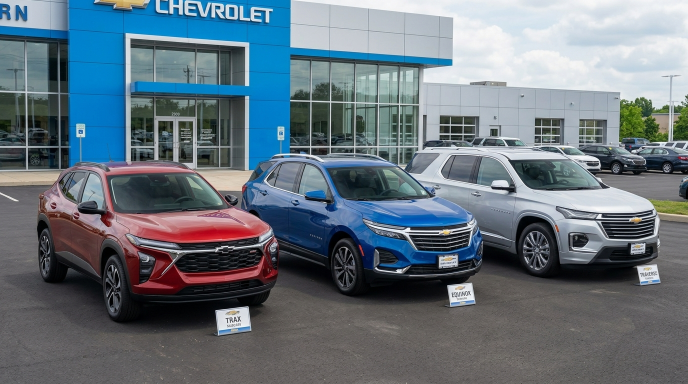
 Chevy Trax, Equinox, and Traverse parked side by side showing their size difference

Chevy Trax, Equinox & Traverse vs. the Competition

Chevy Trax, Equinox, and Traverse vs. the Competition: What Actually Wins Each Comparison Every one of these comparisons gets asked for a reason: Trax, Equinox, and Traverse split by size and price inside Chevy's own lineup, the Equinox goes up against the RAV4 and Tucson on space, the Trax goes up against the Corolla Cross and HR-V on the same thing, and used Equinox shoppers want to know which model years to actually trust. Here's what wins each one, with the numbers to back it up. Trax vs. Equinox vs. Traverse: price, towing, and fuel economy They're really three different classes wearing one badge. Trax is the subcompact, Equinox is the compact, Traverse is the three-row midsize, and the price ladder follows that order exactly: Trax is the cheapest by a wide margin, Equinox costs meaningfully more, Traverse costs more than both. Towing splits even harder. Trax isn't rated to tow anything. Equinox tops out at 800 lbs on front-wheel drive and 1,500 lbs with all-wheel drive, enough for a light utility trailer and not much else. Traverse is rated for 5,000 lbs across every trim, the only one of the three built to actually pull something real. Fuel economy runs the opposite direction of size, which surprises exactly nobody who's ever paid for gas. Trax is EPA-rated around 30 mpg combined. Equinox lands close behind at 27 mpg combined on front-wheel drive, 26 with all-wheel drive. Traverse drops to 22 mpg combined on front-wheel drive, 21 with all-wheel drive, a real gap, about five mpg worse than Equinox and even further behind Trax. Model Price tier Max tow rating Combined MPG Trax Lowest Not rated to tow ~30 Equinox Middle 800 lbs FWD / 1,500 lbs AWD 27 FWD / 26 AWD Traverse Highest 5,000 lbs, all trims 22 FWD / 21 AWD Chevy Trax, Equinox, and Traverse parked side by side showing their size difference Equinox vs. RAV4 vs. Tucson: rear legroom and cargo space Tucson wins both, and it's not particularly close. Tucson's rear seat offers 41.3 inches of legroom and 41.2 cubic feet of cargo behind the second row, ahead of the Equinox's 39.7 inches and 29.8 to 29.9 cubic feet, and well ahead of the RAV4's 37.8 inches and 37.6 to 37.8 cubic feet. Equinox actually beats the RAV4 on legroom despite losing on cargo, RAV4's extra trunk space comes at the cost of rear-seat knee room. Fold the rear seats down and the gaps narrow but don't close: Tucson still leads at 80.3 cubic feet max, RAV4 comes in around 69.8, Equinox trails at roughly 63.5 to 63.9. If maximizing space is genuinely the deciding factor, Tucson is the honest answer here, not Equinox. Where Equinox holds its own is legroom for actual rear passengers, which matters more than cargo cubic feet for anyone regularly hauling people rather than gear. Trax vs. Corolla Cross vs. HR-V: rear legroom and cargo space Trax wins legroom outright and splits cargo with HR-V. Trax's rear seat has 38.7 inches of legroom, ahead of HR-V's 37.7 and well ahead of Corolla Cross's 32.0, a gap big enough to actually feel from the back seat. With seats up, Trax also leads on cargo at 25.6 cubic feet versus HR-V's 24.4 and Corolla Cross's roughly 24.5. Fold the seats down and HR-V edges back in front, 55.1 cubic feet max versus Trax's 54.3 to 54.4, both comfortably ahead of Corolla Cross's 46.9. Trax leads its comparison group in torque too, along with the space numbers above, which is a real edge in a class where most of these small SUVs feel underpowered merging onto a highway. The tradeoff shows up in the seats themselves: reviewers note the front seats are flat, offering little support when taking corners, even though they're nicely padded and comfortable for long drives. Comfortable on the interstate, less confidence-inspiring on an on-ramp. Chart comparing rear legroom and cargo space across Chevy Trax, Toyota Corolla Cross, and Honda HR-V Is a used 2021-2023 Equinox reliable, or should you spend extra to buy new? It depends entirely on which year, and 2022 is the one to actually avoid. 2021 rates as about average for its model year, 2023 rates as good, but 2022 pulls a genuinely poor reliability score and is the weak link in this specific range. The 2021 model also carries four separate NHTSA recalls, including a fuel pump module issue that could cause stalling, worth a completed-recall check on any 2021 you're looking at before you buy. Across the 2020-2024 range broadly, the recurring owner complaint isn't the drivetrain, it's the infotainment screen. Equinox forum threads describe a screen that freezes up and doesn't do anything when touched, then reboots by itself on its own schedule, sometimes as often as once every other week. GM's own technical service bulletin acknowledges the pattern. Some owners report the fix is as simple as pushing on connectors and cables behind the glove box, others needed a dealer to swap in a refurbished unit, and more than one owner mentions trying a software update only to find the system says no update is available every time. None of that is a reason to write off a 2021 or 2023 Equinox, but it's a real thing to test-drive for and ask the seller about, specifically, before you sign anything. If you're choosing between a used 2022 and spending more for new, the reliability data alone makes that an easy call toward new or a different model year. Why choose an Equinox over a Traverse if you have a family of four? Because a family of four doesn't need a third row, and paying for one you'll never use is the actual mistake here. The Equinox seats five and tops out at around 63.5 cubic feet of max cargo. Traverse seats seven to eight and maxes out near 98 cubic feet with both rear rows folded, more room, more seats, more capability on paper. For exactly four people, none of that extra capacity gets used on a normal Tuesday, it only matters on the specific days you're hauling more than four people or more cargo than a compact SUV can hold. Equinox wins the actual daily math: better fuel economy, an easier vehicle to park and maneuver, and a lower price tier for a family that isn't regularly filling extra seats. Traverse earns its keep if towing capacity matters, if a fifth or sixth passenger shows up regularly (a grandparent, a carpool, a growing family), or if cargo space for gear really outpaces what a two-row SUV can carry. "Chevy traverse vs equinox?" is one of the most common ways this question actually gets asked, and the honest answer is that it's not about which SUV is better, it's about whether four seats is a permanent number or a number that's about to change. Bar chart comparing maximum cargo space between Chevy Equinox and Chevy Traverse Bottom line Trax wins on price and fuel economy, Traverse wins on towing, and neither is close on either. Tucson beats both Equinox and RAV4 on space, so if space is the whole decision, cross-shop it seriously rather than staying loyal to the Chevy showroom. Trax edges the Corolla Cross and HR-V on legroom and holds its own on cargo. A 2022 Equinox is the year to be careful with, 2021 and 2023 are safer bets. And for a family of four specifically, Equinox is the right-sized answer unless towing or extra seats are already part of the plan.

2025 Chevy Trax SUV for sale near Long Island City, NY

2025 Chevrolet Trax vs. 2025 Chevrolet Trailblazer

Looking for a Small SUV That Fits Your City Life? If you’re deciding between the 2025 Chevy Trax and the 2025 Chevy Trailblazer, you’re not alone. Both crossovers are practical, stylish, and packed with technology perfect for Long Island City drivers who want efficiency without sacrificing comfort. But which Chevy SUV really fits your lifestyle? Let’s break it down by the questions most drivers ask when comparing these two small SUVs. more How Do the Trax and Trailblazer Compare on Power and Efficiency? The Trax keeps things simple and efficient with a 1.2L turbocharged engine producing 137 horsepower and a 6-speed automatic transmission. It’s front-wheel drive only ideal for urban commutes and tight parking but still manages up to 32 mpg on the highway. The Trailblazer, on the other hand, gives you choices. You can stick with the same 1.2L setup or upgrade to a 155-hp 1.3L turbo engine, paired with available all-wheel drive for extra grip on snowy NY streets. The Trax is great for easy commuting and budget-friendly driving, while the Trailblazer offers more power and traction if you’re venturing beyond the city. What Are the Standout Exterior Features and Style Differences? Here are the key design and style differences between the 2025 Chevrolet Trax and 2025 Chevrolet Trailblazer: Design Feature Trax Trailblazer Engine Options & Drivetrain 1.2L Turbo I-3 (137 hp / 162 lb-ft) — FWD only 1.2L Turbo I-3 (base); optional 1.3L Turbo (155 hp / 174 lb-ft). FWD standard, AWD available Fuel Economy (Combined) Approximately 30 mpg combined (roughly 28 city / 32 highway) Typically around 27–31 mpg combined depending on engine and drivetrain Max Cargo Volume (Seats Folded) About 54.1 cu. ft. About 54.4 cu. ft. Wheel / Suspension / Styling Highlights Lower stance and more car-like proportions; city-friendly design and a simpler FWD setup Taller ride height and SUV-forward presence; optional AWD and more rugged styling (notably on ACTIV trims) How Does Safety & Technology Stack Up? Both models come standard with the Chevy Safety Assist suite (automatic emergency braking, lane keep assist, forward collision alert) and wireless Apple CarPlay/Android Auto. Trax: Offers up to 11-inch touchscreen on higher trims. Trailblazer: 11-inch screen standard, and more optional capability (AWD, more rugged trims) for drivers who want beyond city commuting. For basic safety/tech both are strong; the Trailblazer gives more expandability if you plan more varied driving. What Performance Trade-Offs Exist? Opting for the Trax means simpler, more efficient setup great for city use. The Trailblazer offers more engine/drivetrain options (including AWD), which adds capability but slightly increases cost, complexity, and potentially slightly lower fuel economy in tougher configurations. If your commute is primarily urban, Trax is sufficient; if you’ll take weekend trips, need AWD or extra power, Trailblazer wins. Which Model Offers Better Technology & Connectivity? While both support modern tech (wireless phone integration, large touchscreens in higher trims), the Trailblazer takes the edge in value of standard tech (11-inch screen standard) and ability to add more premium features (premium audio, rugged styling packages, AWD). If tech is a priority, Trailblazer edges ahead. How Do Operating Costs Compare? Trax: Lower entry price, simpler drivetrain (FWD only), fewer options = lower purchase cost and likely lower maintenance cost. Trailblazer: Slightly higher starting price, more drivetrain options, AWD possible = higher cost of ownership potential. Fuel economy difference is modest, so cost/difference in use will come down to how you configure and drive the vehicle. Test Drive the Trax & Trailblazer at Major World Chevrolet Still deciding between the 2025 Chevy Trax and Trailblazer? Visit Major World Chevrolet in Long Island City to compare both SUVs in person, take a test drive, and explore current lease and finance offers. Major World Chevrolet serving Queens, Brooklyn & Manhattan.