




Equinox EV vs. Gas Equinox: Range, Tax Credit, and Charging Explained
Going electric with a Chevy means giving something up and getting something else in return, and the trade is bigger than most shoppers expect walking in. Here's the real range gap between the Equinox EV and the gas Equinox, where the federal tax credit actually stands, what a home charger setup costs before delivery day, and how the Equinox EV and Blazer EV actually compare at a fast charger.
How does the Equinox EV's real-world range compare to the gas Equinox?
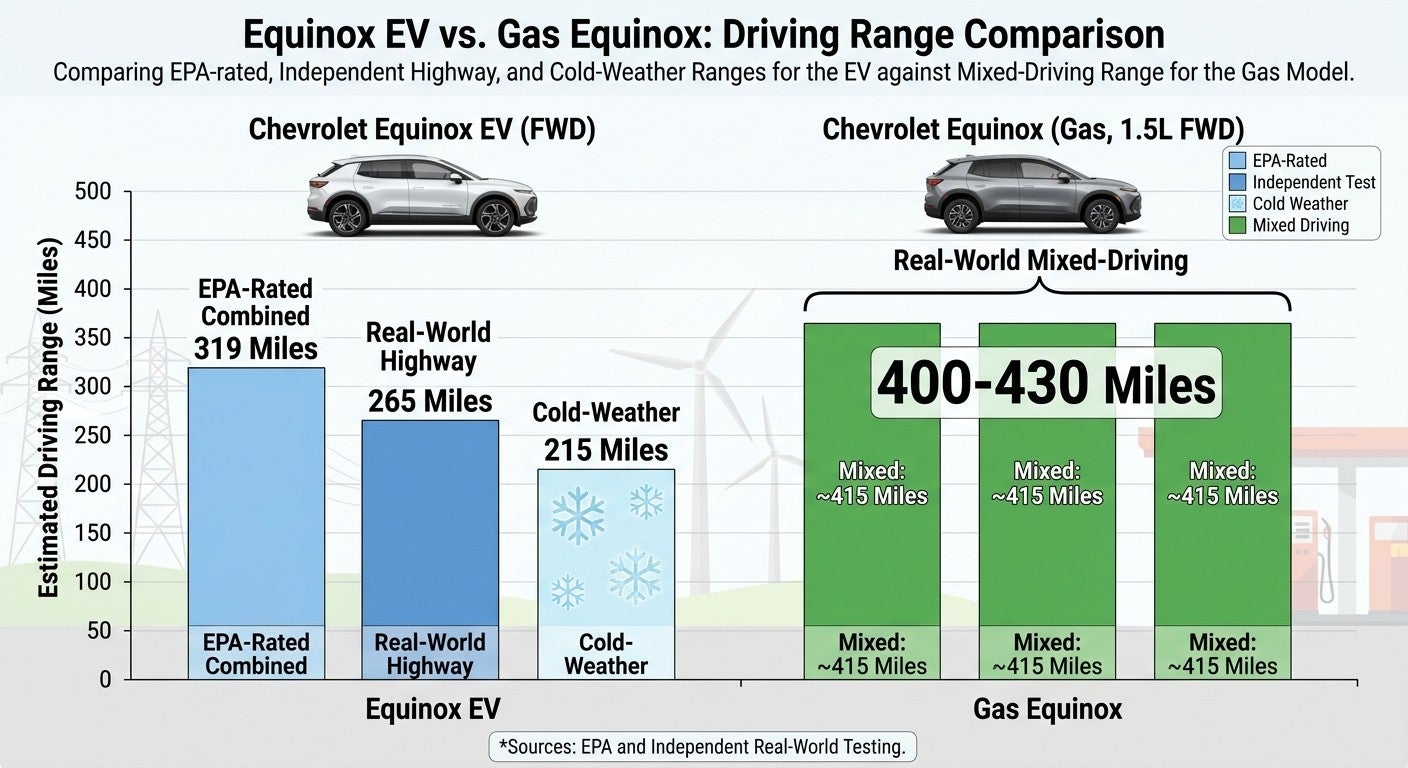
Roughly 230 to 260 miles for the Equinox EV against 400 to 430 miles for the gas Equinox in mixed driving, so figure the gas model goes about 60 to 70% farther between fill-ups than the EV goes between charges. The EPA numbers look closer than that, 319 miles for front-wheel-drive Equinox EV, 307 for all-wheel-drive, but independent highway testing at 75 mph lands both versions closer to 260 miles, and that's before winter takes a bite out of it.
Cold weather changes the math further. In 6°F weather during a 60-mile drive, the energy monitor showed 1.6 to 1.7 miles per kWh on the way out, improving to 2.2 miles per kWh on the return trip as the battery warmed up. You can easily see range dropping to 100 miles during a bad winter storm. The gas Equinox doesn't have that problem, cold weather costs it a little efficiency but nothing close to a third of its range.

Does the Equinox EV or Blazer EV still qualify for the federal EV tax credit?
No. The federal EV tax credit that used to knock a meaningful chunk off the price was eliminated for new-vehicle purchases by recent legislation, and that applies to the Equinox EV and Blazer EV the same as every other EV on the market. The credit that used to make these two Chevy EVs a lot cheaper on paper is simply gone for a normal new purchase.
There's one narrow exception worth knowing about: as long as a shopper entered a binding contract to buy a vehicle before the cutoff, the purchase can still qualify for the credit even if the car wasn't delivered until later, provided a real down payment or trade-in changed hands before that date too. Outside of that specific paperwork trail, what's left is smaller and comes with fine print. Finance a U.S.-assembled EV, and both the Equinox EV and Blazer EV qualify since they're built here, and you can deduct a meaningful chunk of your auto loan interest each year under a separate provision, a real benefit, but nowhere near what the old purchase credit was worth. There's also a modest home-charger installation credit, but only if you happen to live in a low-income or non-urban census tract, most suburban buyers won't qualify for that one at all. Do the math yourself before you get excited: none of it comes close to replacing what used to come straight off the purchase price. Tax law shifts more than most car buyers expect. Confirm the actual rule before you build a budget around any of it.
What home charging equipment do you need before delivery, and what does it actually cost?
A dedicated 240V circuit and a Level 2 charging unit, and the honest range runs from a few hundred dollars for a straightforward install to well into four figures if your electrical panel needs work. That range breaks down roughly like this once you actually itemize a quote: a modest sum for the charger unit itself, a comparable amount for a licensed electrician's labor, and a smaller add-on for permits and inspection, which most jurisdictions require for any 240V work. Nobody quotes it that way up front, dealers and chargers both tend to just hand you a single number, but knowing the pieces helps you tell whether a quote is padded.
The real cost driver isn't the charger, it's what's already in your garage. A Level 2 setup needs a dedicated 40 to 60 amp circuit, and if your panel is already near capacity, a panel upgrade or sub-panel adds a genuinely significant amount on top of everything else, often more than the rest of the install combined. This is exactly where quotes tend to balloon when the electrician discovers surprises: a cramped or ancient panel, aluminum branch wiring, a hidden splice. Get an electrician to actually look at your panel before you assume the low end applies to you, and get the quote in writing before delivery day, not after the car is already sitting in your driveway on a Level 1 trickle charge.

How long does it take to DC fast charge an Equinox EV vs. a Blazer EV?
About the same, unless you pay up for the Blazer EV's bigger battery option. Both the Equinox EV and the base Blazer EV configurations use an 85 kWh battery capped at 150 kW peak DC fast charging, and real-world testing on that setup shows the car rarely holding above 96 to 100 kW even on a faster charger, which puts a realistic 10 to 80% charge at around 40 to 44 minutes rather than the sub-30-minute numbers some EVs advertise.
Step up to the Blazer EV's RWD or SS AWD trim with the larger 102 kWh battery and the peak charging rate jumps to 190 kW, GM's own numbers claim up to 80 miles added in about 10 minutes on that configuration versus roughly 68 miles for the standard Blazer EV and 77 miles for the Equinox EV. The Equinox EV doesn't offer that bigger battery at all, so if fast-charging speed specifically is the deciding factor between these two, it comes down to which Blazer EV trim you're looking at, not which nameplate.

Bottom line
The range gap is real and worse in winter, plan around 230 to 260 miles for the EV against 400-plus for gas, not the EPA sticker numbers. The federal tax credit that used to make new EVs meaningfully cheaper is gone for a normal purchase, so don't build your budget around it unless you locked in a binding contract before the cutoff. Home charging installation typically runs from a few hundred dollars to a couple thousand, but get your panel checked before you trust the low end, panel work is what turns a cheap install into an expensive one. And on fast charging, Equinox EV and base Blazer EV charge at the same modest pace, the only way to actually charge faster is stepping up to the Blazer EV's bigger battery trims.